
Spotlight on AM17: Alberto Vital Presents esaFEMM, the Predecessor to MAGNETISiM
Welcome back to the MAGNETISiM blog! Today, we are diving into our archives to revisit a pivotal moment in our development journey. We are breaking down the recent paper, poster, and presentation delivered by Alberto Vital at the AM17 conference.
Alberto Delgado
5/6/20252 min read
Welcome back to the MAGNETISiM blog! Today, we are diving into our archives to revisit a pivotal moment in our development journey. We are breaking down the recent paper, poster, and presentation delivered by Alberto Vital at the AM17 conference.
His presentation focused on esaFEMM—the innovative, open-source tool that successfully bridged the gap between complex electromagnetic simulation and practical manufacturing, ultimately laying the technological groundwork for what MAGNETISiM is today.
The Context: Why the Industry Needed a Change
Designing magnetic components for high-efficiency power converters—especially in demanding fields like space applications—is no easy task. During his talk, Alberto highlighted a persistent bottleneck in the engineering workflow:
Engineers often find themselves caught between two extremes: relying on basic analytical calculations that fall short for complex planar designs, or wrestling with highly expensive, complex commercial Finite Element Analysis (FEA) software.
esaFEMM was introduced as the missing link: an open-source Graphical User Interface (GUI) that makes advanced FEA accessible, fast, and highly practical for planar conductors.
Key Highlights from the Poster and Presentation
Alberto’s poster and accompanying talk walked the audience through the core architecture of the tool, demonstrating how it solves real-world engineering problems. Here are the main takeaways:
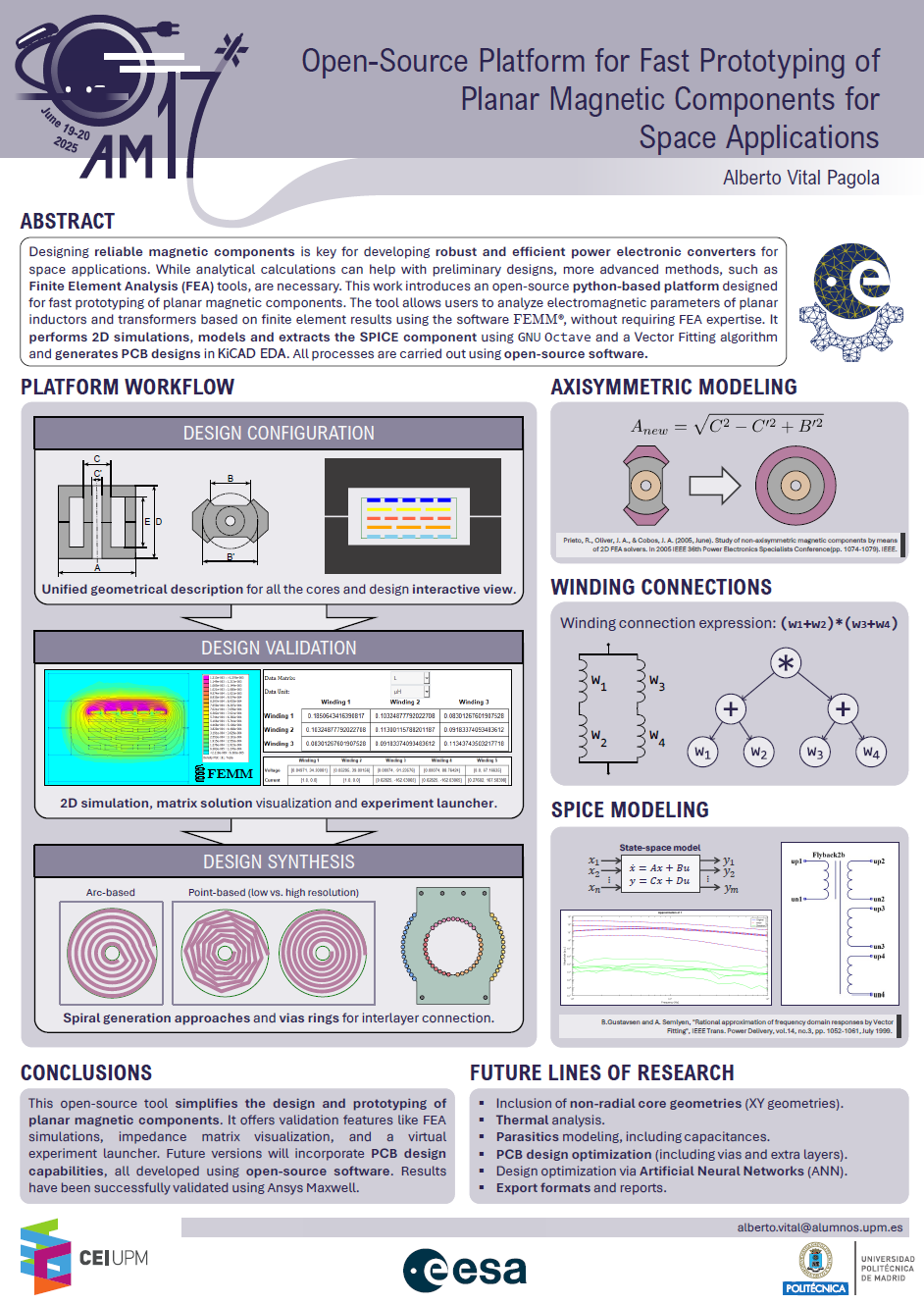
Democratizing FEA with a Smart GUI: Under the hood, the tool utilizes the powerful FEMM® engine to solve low-frequency electromagnetic problems. However, setting up models in raw FEMM can be incredibly time-consuming. Alberto showcased how the Python-based GUI allows users to input core and winding geometries intuitively, without needing to be an expert in finite elements.
The 3D to 2D Translation Magic: Because FEMM® operates in a 2D domain, simulating 3D commercial cores (like RM, PT, and PH) presents a challenge. The poster detailed the elegant mathematical solution integrated into the software: it automatically translates 3D geometries into 2D axisymmetric models by maintaining the exact reluctance of the gap. This ensures high accuracy while drastically reducing simulation time.
Automated Electromagnetic Analysis: The presentation demonstrated the tool's ability to automatically run multiple simulations across different frequencies and layers. This allows engineers to easily extract the full impedance matrix, evaluate winding connections, and perform simulated load tests with just a few clicks.
From Screen to Prototype (AutoPCB): Perhaps the most celebrated feature highlighted in the talk was the "AutoPCB" generation. Alberto explained how the software doesn't just simulate—it builds. By integrating directly with KiCad, the tool takes the validated parameters and automatically generates the Gerber files needed to manufacture the physical printed circuit board (PCB).
The Legacy: Paving the Way for MAGNETISiM
Alberto Vital’s presentation at AM17 was more than just a software showcase; it was a proof of concept for a new way of working. The enthusiastic reception of esaFEMM proved that the power electronics industry is hungry for streamlined, accessible, and integrated design tools.
The philosophies and technical breakthroughs presented in this work—fast prototyping, open-source integration, and user-centric interfaces—are the very DNA of MAGNETISiM. We are building upon this incredible foundation to bring you even more powerful and versatile magnetic design capabilities.
Get in touch
MAGNETISiM TEAM
© 2025. All rights reserved.
Universidad Politécnica de Madrid
