
esaFEMM: Democratizing Magnetic Component Design for Space Applications
Researchers from the Universidad Politécnica de Madrid and the European Space Agency (ESA) presented an innovative solution at the 13th European Space Power Conference (ESPC) 2023 : a tool called esaFEMM.
CONFERENCES
Alberto Delgado
6/2/20232 min read
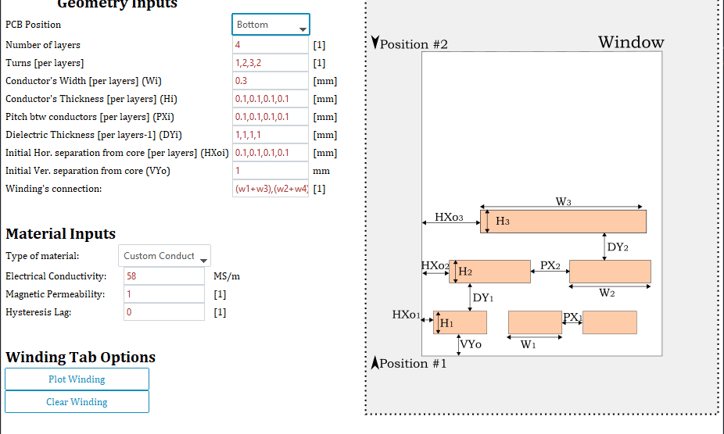
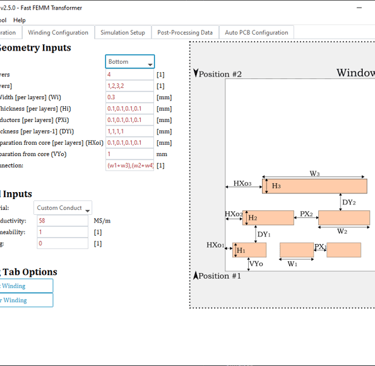
In the demanding field of space applications, developing robust and efficient power electronics converters is crucial. A key factor in ensuring this efficiency is the optimization of magnetic components. While analytical equations can help estimate inductances and core losses in the early stages, the precision required for these applications ultimately demands powerful Finite Element (FE) tools.
The challenge? Commercial FE software, such as Ansys Maxwell® or Comsol Multiphysics, provides all necessary parameters but can be prohibitively expensive and complex to use. On the other hand, open-source alternatives like FEMM® exist, but their interfaces are notoriously difficult to navigate, and drawing all parts of a magnetic component manually is highly time-consuming.
To bridge this gap, researchers from the Universidad Politécnica de Madrid and the European Space Agency (ESA) presented an innovative solution at the 13th European Space Power Conference (ESPC) 2023 : a tool called esaFEMM.
What is esaFEMM?
esaFEMM is an open-source graphical user interface (GUI) specifically focused on the fast prototyping of magnetic components based on planar conductors, such as printed circuit boards (PCBs).
This Python-based tool acts as a user-friendly bridge. It allows engineers to analyze the electromagnetic parameters of planar transformers or inductors using the powerful FEMM® engine, completely removing the need for prior expertise in finite element analysis.
Key Features and Advantages
esaFEMM automates and simplifies the traditional simulation workflow through several standout features:
Intuitive Core Modeling: The tool natively includes models for the most commonly used commercial magnetic cores in the industry, such as RM, PT, and PH geometries.
Smart 3D to 2D Conversion: Because FEMM® is limited to 2D simulations, simulating 3D cores directly is a challenge . esaFEMM solves this by automatically translating 3D core geometries into 2D axisymmetric models. It does this using an approach that ensures the gap reluctance remains equal, drastically speeding up simulations without sacrificing accuracy.
Fully Customizable PCB Windings: Users can easily configure the winding geometry for their planar conductors. The interface allows customization of the number of layers, turns per layer, conductor width, thickness, and dielectric spacing.
Automated Electromagnetic Analysis: The software automatically runs simulations for each defined frequency and layer to extract the full impedance matrix. It also allows users to perform short-circuit, open-circuit, and load tests directly within the app.
Proven Accuracy: Validating a new tool is critical. The developers have shown that the impedance matrices and results provided by esaFEMM display very good agreement when compared to industry-standard commercial software like Ansys Maxwell®.
From Simulation to Physical Prototype
Perhaps one of the most exciting features of esaFEMM is that it doesn't stop at simulation. The final section of its workflow includes an AutoPCB Generation tool.
Once a magnetic component design is simulated and validated, the software connects with KiCad—a free, open-source electronics design suite—to automatically generate preliminary PCB designs and Gerber files. This drastically reduces the time it takes to move from a theoretical design to a physical prototype ready for manufacturing.
Conclusion: A Boost for Open-Source Engineering
The esaFEMM project represents a significant step forward in making advanced power electronics design more accessible. By combining a simple GUI with powerful free software like FEMM and KiCad, esaFEMM empowers engineers, researchers, and students to iterate faster and design planar magnetic components without being bottlenecked by software complexity or licensing costs.

Get in touch
MAGNETISiM TEAM
© 2026. All rights reserved.
Universidad Politécnica de Madrid
